Field note
Not Yet
What a mountain's refusal teaches that a summit never could.
By Mehdi Moutahir
A personal reflection on the first run of Liminal Ascent, which I set for myself before bringing anyone else near it. This was the self-directed original, and what the mountain taught me shapes everything that comes after.
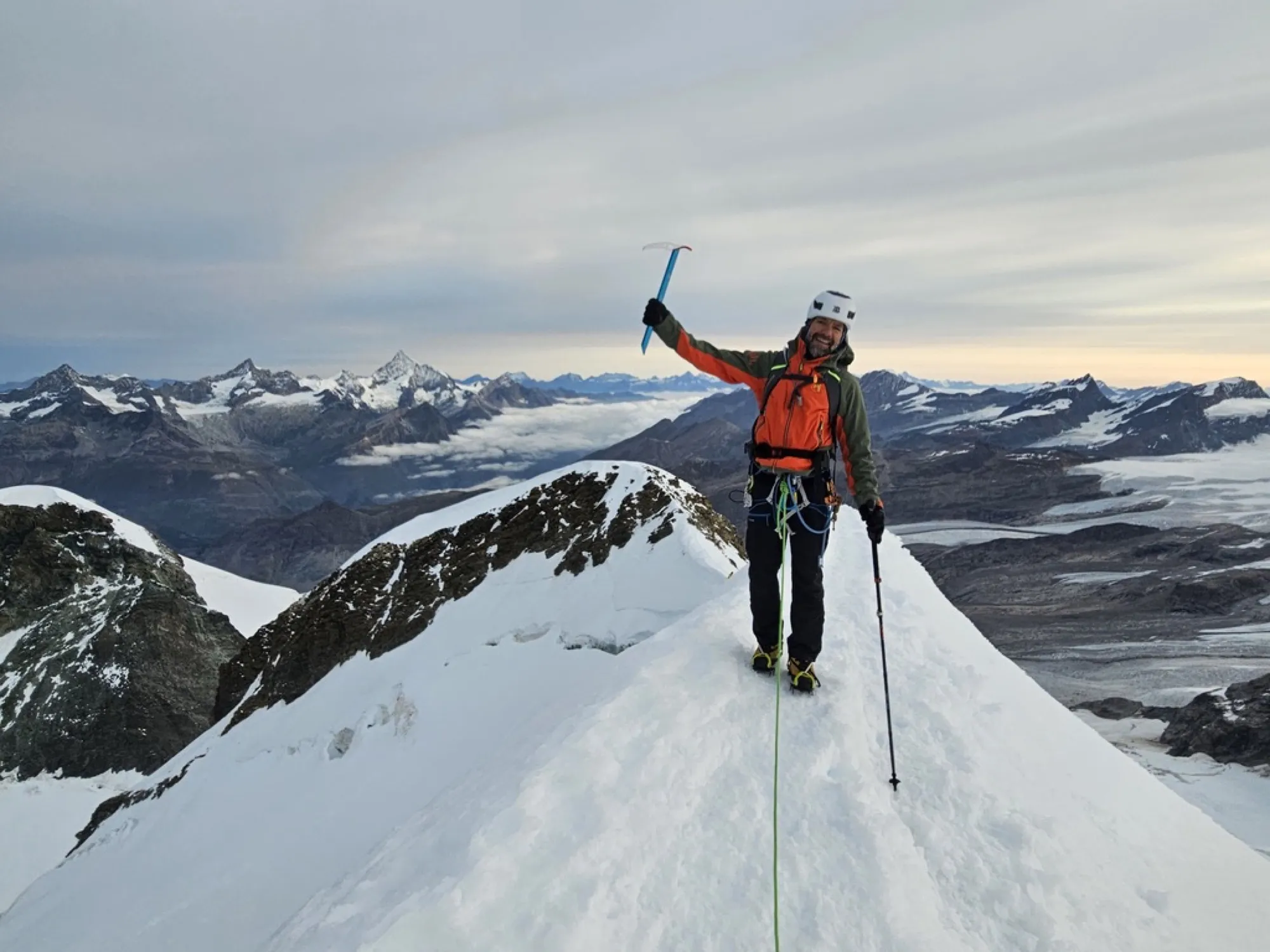
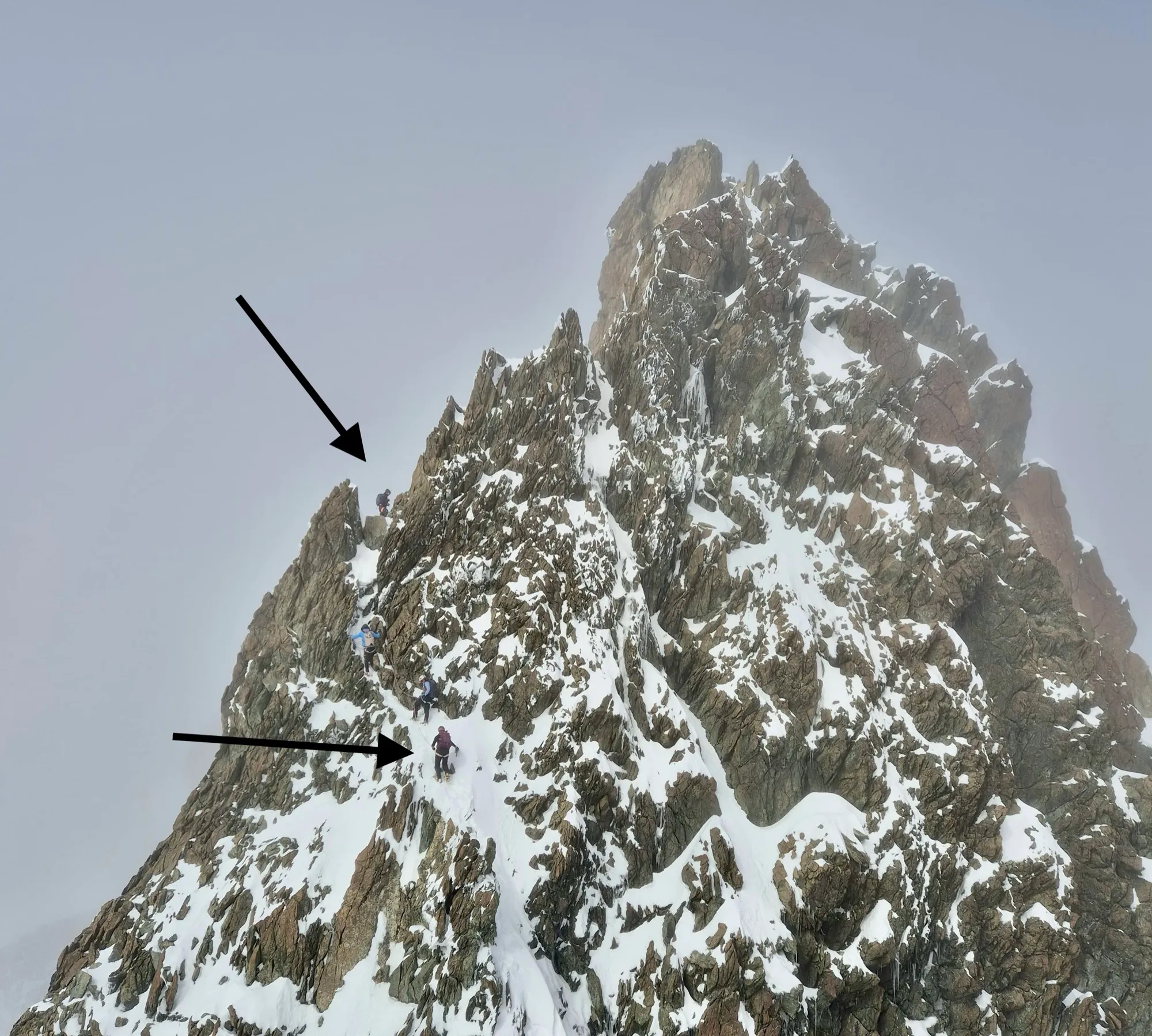
The ridge was rock, a spine of it barely wider than my two boots, and on either side it dropped toward a different way to die.
It should have been the safe part. Rock is what you want under your hands up there, edges and honest holds, the kind you can grip and trust. But snow had fallen in the night and left a thin greasy skin over all of it, filling the cracks, glazing the ledges, turning every edge that should have bitten into something that might simply let go. I moved over blocks and steps of good stone. The crampon points skated and scratched on it, and my gloved fingers kept testing holds that looked solid and were not.
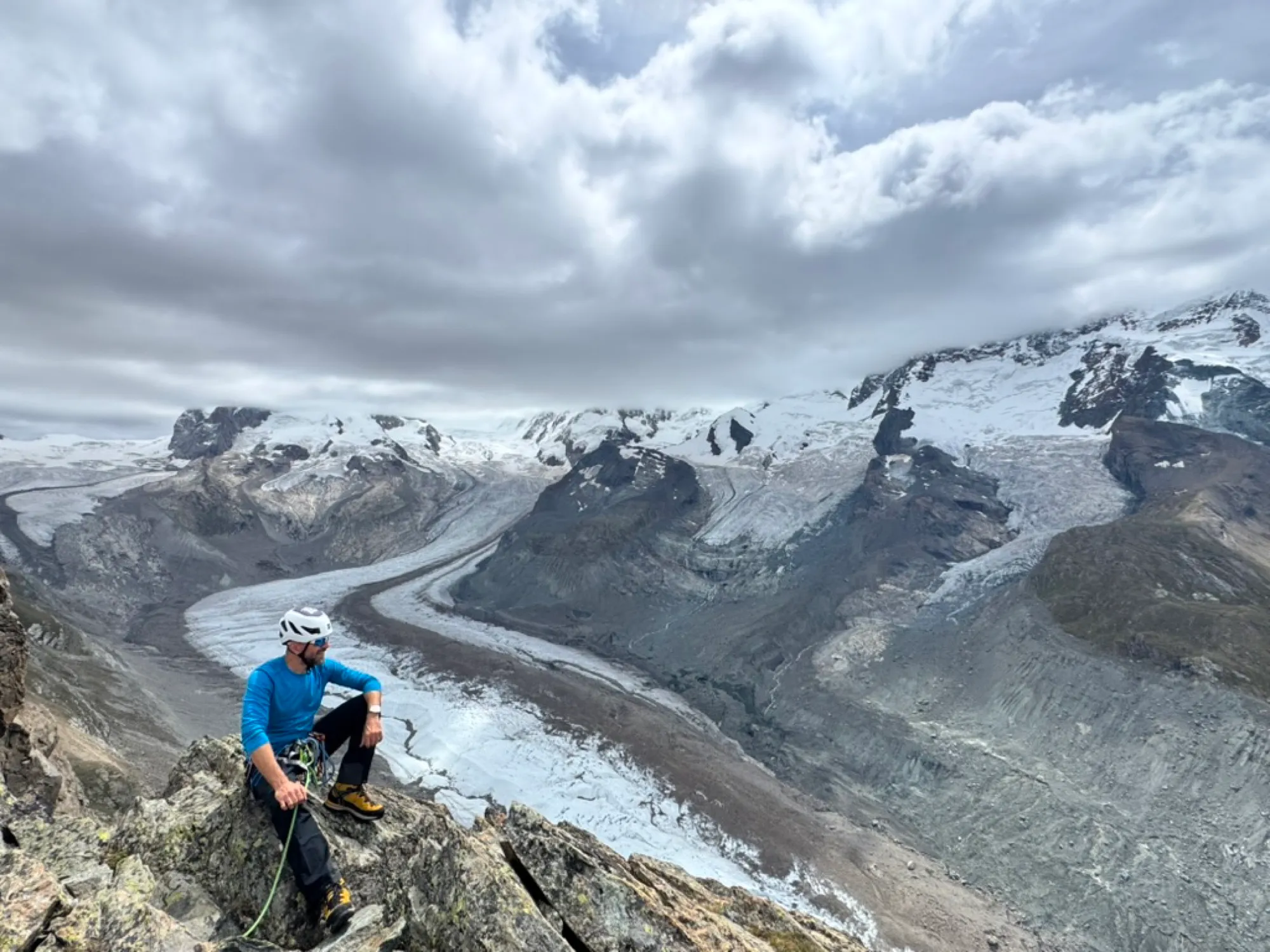
To the left the mountain dropped away toward Italy, the snowfields plunging hundreds of metres to the Verra Glacier before the valley carried them further still, a steep alpine face where a slip would not be a fall so much as a long acceleration with no bottom in reach. To the right it was worse, and I could not even see it. That was the North Face, falling most of a kilometre toward the glaciers above Zermatt, and a cloud had risen up beneath the ridge and swallowed it whole, so that over that edge the horizon simply stopped and there was nothing but white with no floor anywhere in it. You would think the drop you can see is the frightening one. It is the one you cannot see that does the work, because the mind fills it.
The climbing itself was never desperate. A slab, a chimney, a narrow crest, and then the little tower everyone warns you about, an awkward sequence where you commit your whole weight out over a notch before you can regain the ridge on the far side. On paper none of it is hard, moves a competent climber makes without thinking. But grades lose their meaning when the consequence of a single mistake hangs far beneath your boots. I was following a line of rock the mountain had drawn for no one, roped to a guide named Thomas I had met three days before.
Exposure rewires you. On flat ground your attention sprawls in every direction. Up there it collapses to a corridor exactly as wide as the next hold. I could hear the scrape and catch of steel points on stone, the small test each hand made before it trusted its weight to anything, my own breath going out and in on a rhythm I had stopped being able to claim as mine. There is a kind of calm that lives on the far side of real fear. Not peace. Total, narrowed, animal attention. Nothing in me was rehearsing the past or reaching for the future. There was the rock, the rope, Thomas, and the next hold tested and trusted and weighted, one at a time.
This was the Breithorn half traverse. I had not meant to be up here at all that week. I had meant to be on the Matterhorn.
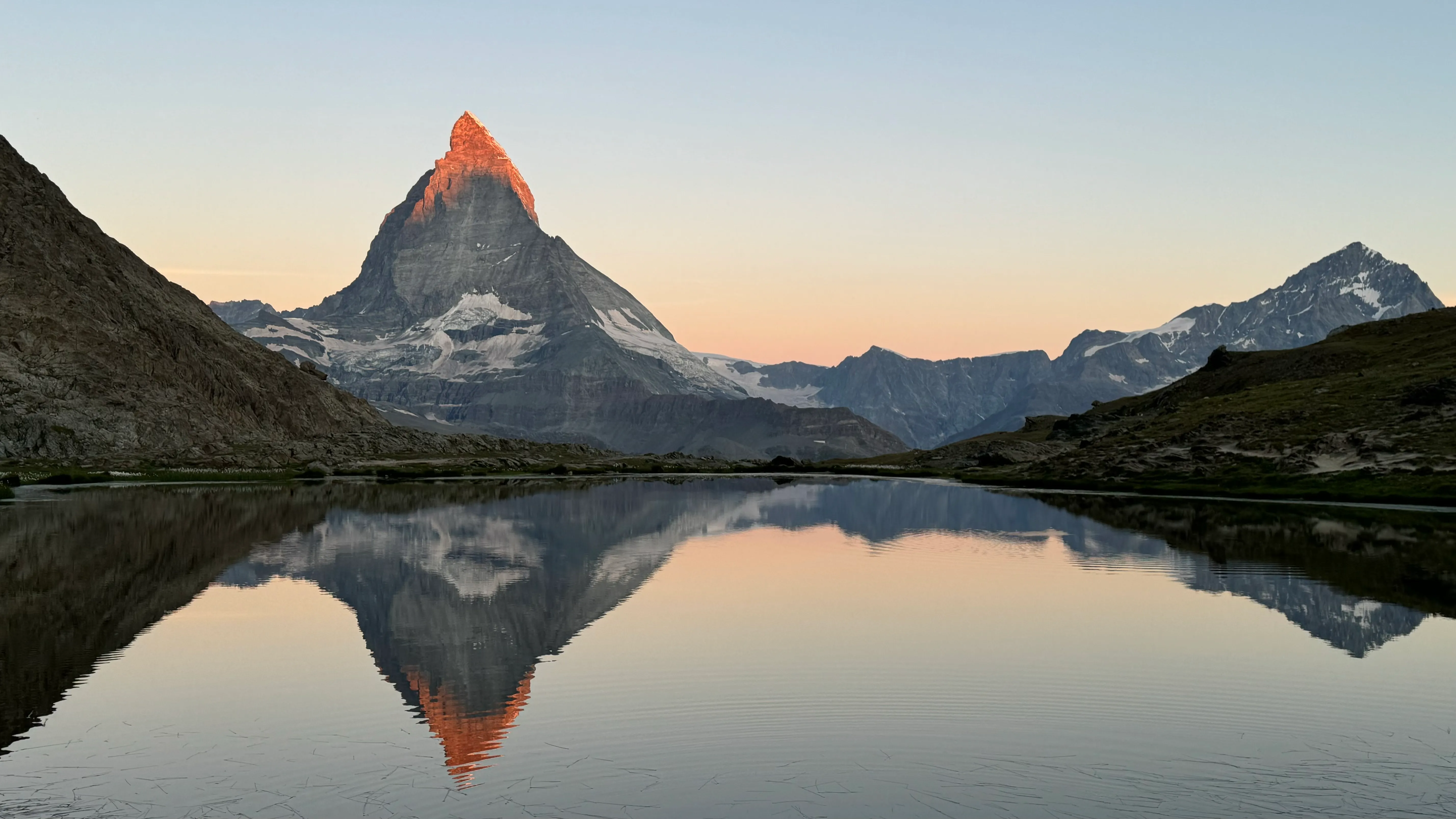
But the Matterhorn had said not yet.
The morning I was meant to climb, it was raining. The day before, a fifty-eight-year-old South Korean climber had fallen to his death on the descent from the Hörnli ridge, somewhere near 4,000 metres. On that rock wet is not inconvenient. It is lethal, the slabs turning to glass and the whole calculation of the route sliding out from under everyone on it. Not one guide in Zermatt would take a client up, and they were right. Johannes, the man I had taken on for the Matterhorn, wore the title Bergführer better than anyone I met. He had summited the mountain five times that summer alone and more than fifty times before, and he walked on a permanently swollen ankle and still topped four-thousanders several times a week. When a man like that reads the sky and says not today, you do not argue. You feel the whole month you spent arranging yourself around a single morning quietly close.
The mountain had done this before, to better men. On the fourteenth of July, 1865, Edward Whymper became the first human being to stand on the Matterhorn’s summit, after seven attempts and years of obsession. He had beaten it. And on the way down the rope broke, and four of the seven men in his party went off the north face and did not stop. Whymper lived to write the line every climber eventually learns in the flesh.
Climb if you will, but remember that courage and strength are nought without prudence, and that a momentary negligence may destroy the happiness of a lifetime. Do nothing in haste; look well to each step; and from the beginning think what may be the end.
The end, not the summit. The long descent the triumph story forgets to mention, where most of the dying is done, the part after you finally get the thing you came for. The man the day before had died on the descent, exactly where Whymper lost his four.
There was a mercy in it I could not feel at the time. A summit reached in the wrong hour is a debt, and the debt comes due on the way down. What turned me back was older than me, made of weather and rock and the names cut into the churchyard wall in Zermatt, and it was keeping me from a summit I was not yet ready to come down from.
We walked down to Schwarzsee in silence. Johannes told me later I looked defeated. Then, partway down, he spoke.
“Have you ever done the traverse?”
The Breithorn half traverse, he meant. No, I said.
“Before you try the Matterhorn,” he said, in a thick German accent, flat and matter-of-fact as a weather report, “you should do that one first. It will show you what climbing exposed really feels like.”
It landed like a consolation prize. It was really a set of directions. Not yet, the mountain had said: go and become the person this climb asks for, and come back. It would be the better part of a year before I heard those two words for what they were, and felt the charge in them: the particular ache of being made to wait for the thing you feel you have earned but still cannot have.
I was not in the Alps for a summit photograph. I was there to run the first ascent of something I mean to bring other people into. I call it Liminal Ascent: a month in the high Alps, a sequence of climbs and mountain races meant to take a person apart at altitude and put them back together. But the program is only the outward shape of it. Underneath runs the thing that designed it, a protocol I have been living for a few years now, a way of authoring a self on purpose. I call it the Becoming Protocol. It shaped the Liminal Odyssey, the previous summer’s voyage under sail through the Greek islands, and now this adventure. I could not ask anyone to trust me at the foot of their mountain until I had climbed my own. So I went first, the subject of my own experiment.
And it did not begin in the Alps. It began months earlier, and it began carefully. Before I loaded my body with any of what was coming, I brought in a coach who put me through the Functional Movement Screen, the seven-pattern assessment trainers and physical therapists use to surface the asymmetries and weak links that turn, under enough load, into the injury that ends your season. We found a few, and spent weeks fixing them before I put real weight on anything.
Only then the engine. On a step-up box in Providence, Rhode Island, where the highest summit for miles is the Superman Building, a lone art-deco tower downtown that got its nickname from looking like somewhere Clark Kent would work. Step up, step down, step up, step down. I had built the box myself and set it in front of a television big enough to make me feel like I was on the mountain, doing hours on it while climbers ground their way up Mont Blanc, or getting quietly psyched watching Alex Honnold move up the bare face of El Capitan without a rope in Free Solo. There is no dignity in it, none, just a grown man in his socks stepping onto it and off again, ten thousand times, in the houseplant-filled apartment he had named the Botanical Sanctuary of Becoming.
Hanging off a pull-up bar screwed into a doorframe until my forearms failed and then holding a beat longer, because the rock does not care what you can lift, only how long you can keep holding on. The steep pitches of College Hill for the legs, the long flats of the East Bay bike path for the hours, the low Blue Hills outside Boston for time on my feet, week after week, until the only proof of any of it was a resting heart rate that kept dropping and a grip that took a little longer each week to give out.
Then the mountains themselves, in rounds. First the Riffelhorn, that dark tooth of rock above the Gornergrat that guides use to read a client the way a doctor reads a chart, and where I first put real rope work to the test, the knots and belays and short-roping I had only drilled on flat ground. The schist bit through the skin of my fingertips, cold and sharp under the pads as I weighted a hold the size of a coin, and there is a move on that rock where you commit your whole body to friction, a smear on nothing, boot rubber and faith the only things between you and the long grey drop that opens under your heels like a held breath. My left leg began to sew, that fast sewing-machine tremble, the muscle firing past its own control. Emmanuel, my French guide, said nothing. He was watching one thing: whether my hands kept working while the nervous system screamed. They did.
Trust is not a feeling you generate at the ledge. You build it by inches, grip after grip, every hold that took your weight and gave it back, until the body has gathered enough evidence to stake its life on the next one.
Then the mountaineering block. I walked up the Breithorn the gentle way, the summit they sell as the easiest of the four-thousanders, a clean white slope with a view. They sell it as easy right up until you are a third of the way up, out of breath and cold and quietly questioning every life choice that delivered you there, because up there the air comes thin and half-empty, and your lungs haul at it and still come up short. No StairMaster at Equinox, no cardio kickboxing class at Gold’s Gym, teaches your body what to do with that.
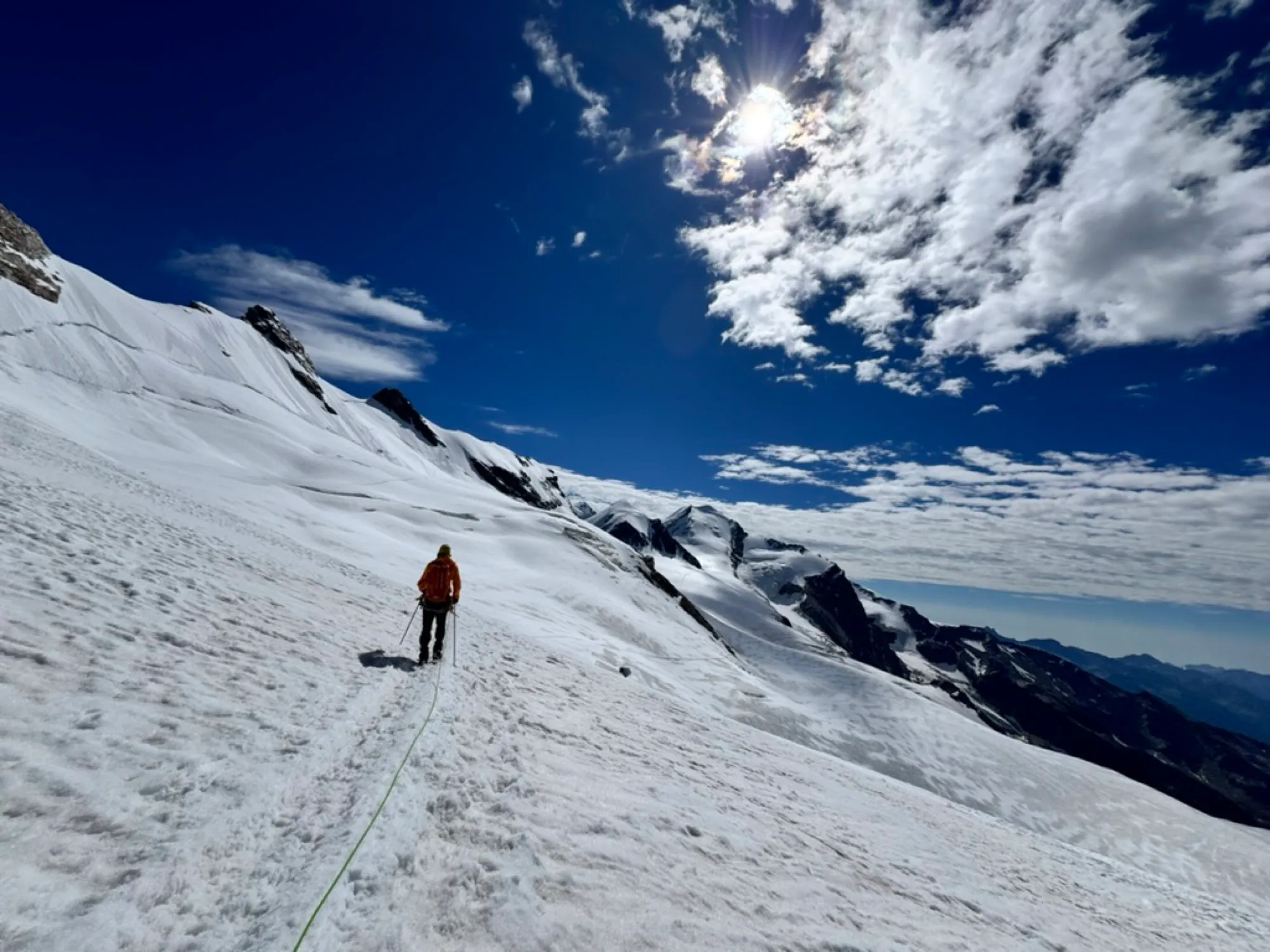
There was no celebration on top of the Breithorn either. A photograph, half a minute, and the guide was already turning to go. We had to move, and move faster, to reach the refuge before the sun softened the snow and the fragile bridges over the crevasses began to give. So began the unglamorous and tedious part no one prepares you for. Hours of flat, roped, relentless walking behind a guide who moved as if out for a pleasant stroll, almost frolicking, while I suffered to hold his pace, thirsty and short of breath, across a glacier that gave you nothing to aim at and nothing to break the white, only more white, more ice, and the sound of your own breathing. Every so often a crevasse opened beside the track, a blue throat in the snow that looked exactly like the place you would slip into and simply stop being, and then a snow bridge would carry you over it and you would keep walking.
We reached the Rifugio Guide d’Ayas in the early afternoon, and resting there was its own ordeal. I had climbed too fast for the altitude, and it made me pay with a blinding, nauseating migraine, dehydration and a slow vice tightening behind my eyes. I lay in the dark of the dormitory and breathed and waited, and after a nap it loosened just enough to let me stand.
And then, dinner. A long table in a refuge of stone and wood and copper at around 3,400 metres, on the Italian side of a ridge it shares with Switzerland, packed with climbers who had come a long way to be there. We passed food and passed stories, strangers an hour earlier, and I sat listening to people name the private reasons that had hauled them up the same glacier, in many languages and accents, for something none of us could quite put into words.
Sleep barely came. You do not rest up there, in a bunkroom with three other climbers, the altitude keeping the body half-awake all night, a rotation of snoring, the ripe smell of the boots and the feet that had been in them. I lay there breathing shallow and watched the hours go.
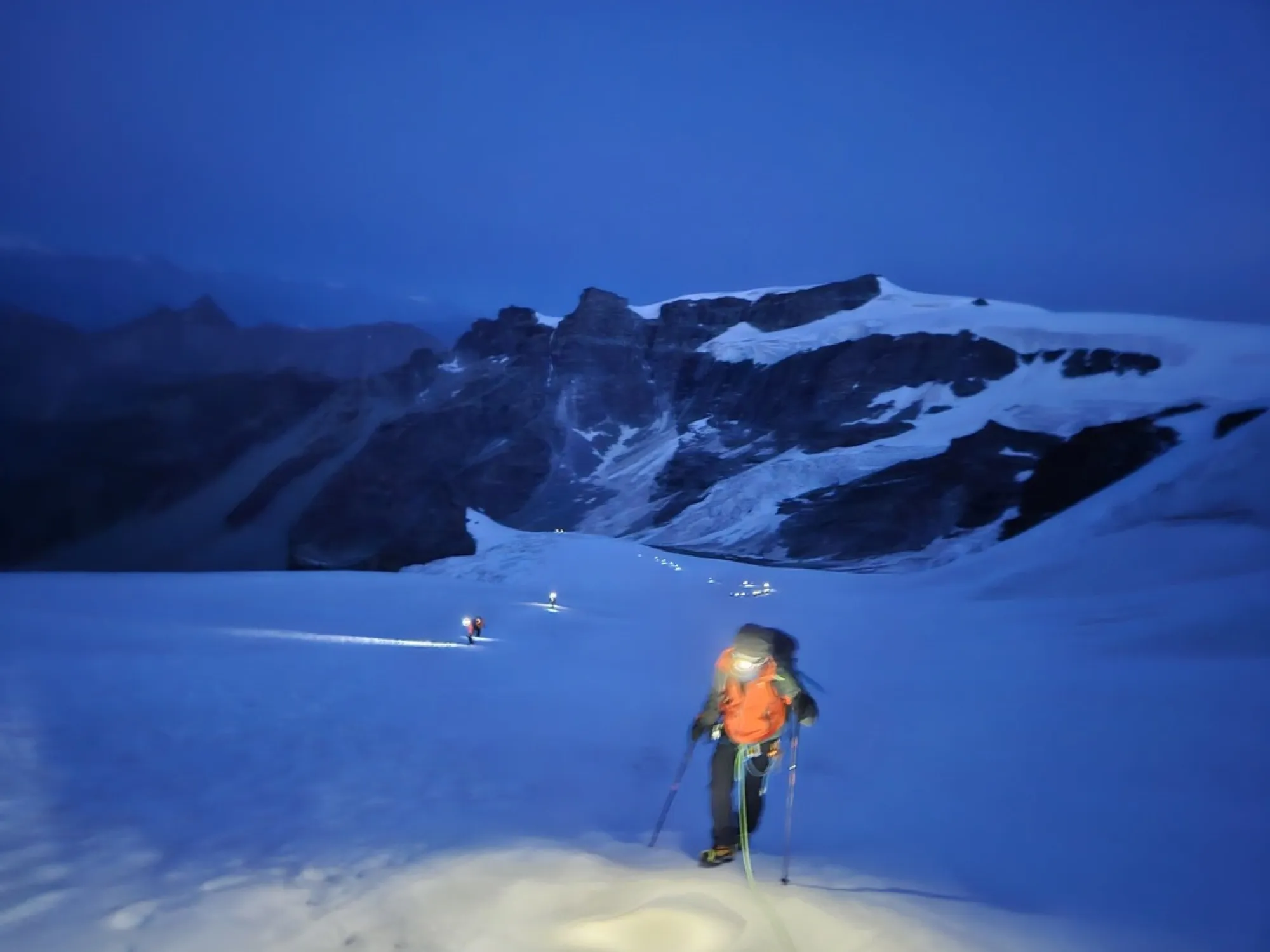
The alarm went at 3:45, to be laced and roped and out the door by 4:30, first onto the glacier, ahead of everyone. There is a hard logic to going first. On a glacier the last thing you want is to be stuck at the back of a long line, boxed in, moving at the pace of the slowest and the most tired, on ground that does not forgive a bottleneck. So we walked out into it in full dark, and I still have not worked out how Emmanuel found the way. There was nothing to navigate by. Pitch black, a few stars overhead, and ice in every direction as far as sight reached, no track, no marker, no line drawn on the snow, and a guide walking into all of it as though he could read something written on the dark that I never could. I followed. Half of that month was learning to trust a rope to a man who could see where I couldn’t, and to keep walking into it anyway. Castor came up out of that blackness slowly. Crampons crunching into the hard snow, the rope running out ahead to Emmanuel, his life on my footing and mine on his. You do not conquer a thing like that. You are permitted across it, and the permission can be pulled back between any two steps.
This was harder and stranger than anything I had done to that point, because I had never climbed a glacier in my life. I had trained endurance and lungs and legs. I had not trained this. Front-pointing up a face of ice at dawn, a heavy pack of gear and supplies on my back, swinging an axe into it and trusting the bite, and there were moments the axe did not bite, moments it skated or came free with a sickening lightness and my whole body went weightless for half a second before it caught. Nothing but ice on either side, falling away into the dark, and one clean thought running under the fear, honest and absurd at once: what the fuck am I doing here. I had no business being on that face at 5am, learning it live, with the drop already under me.
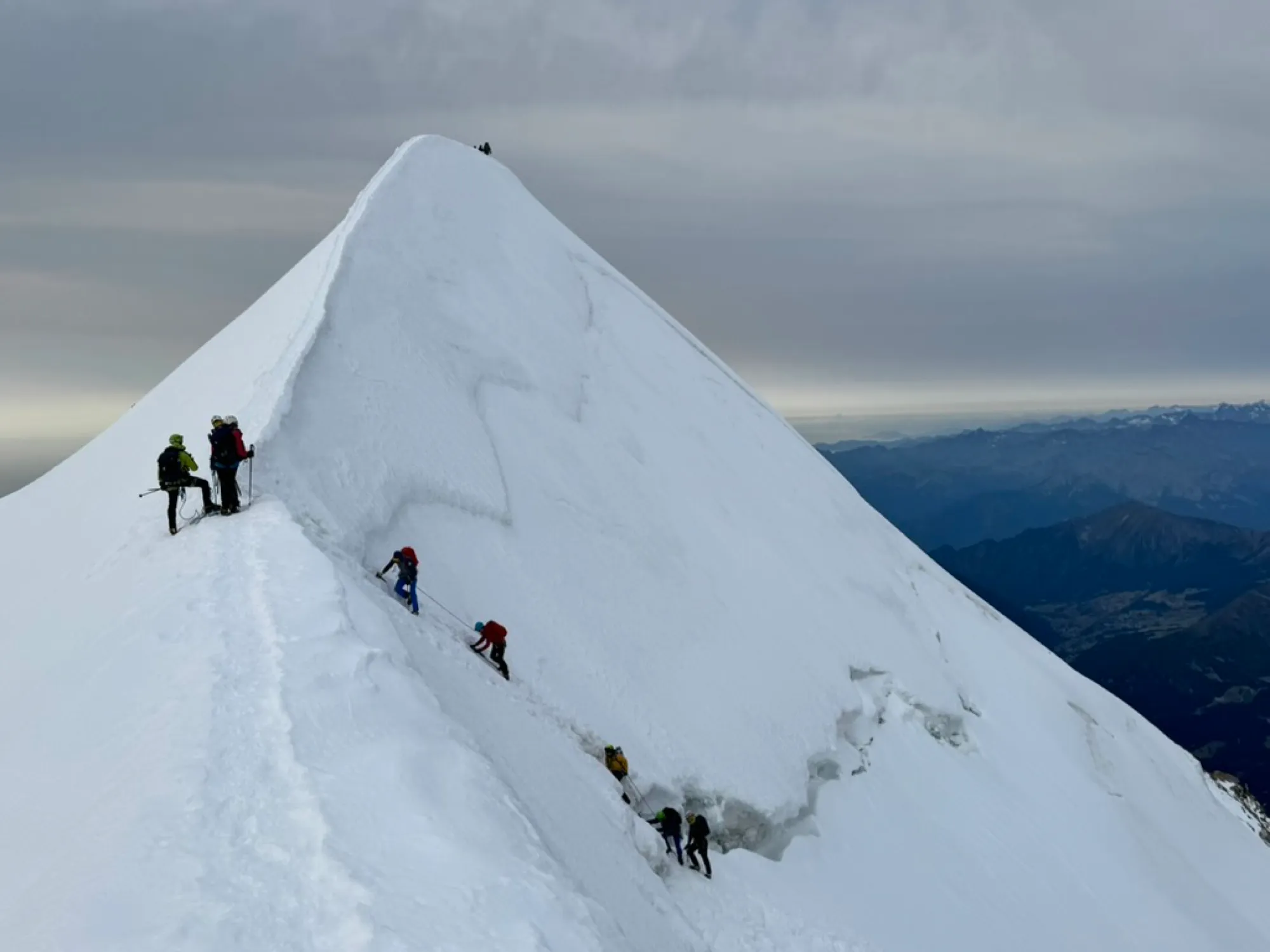
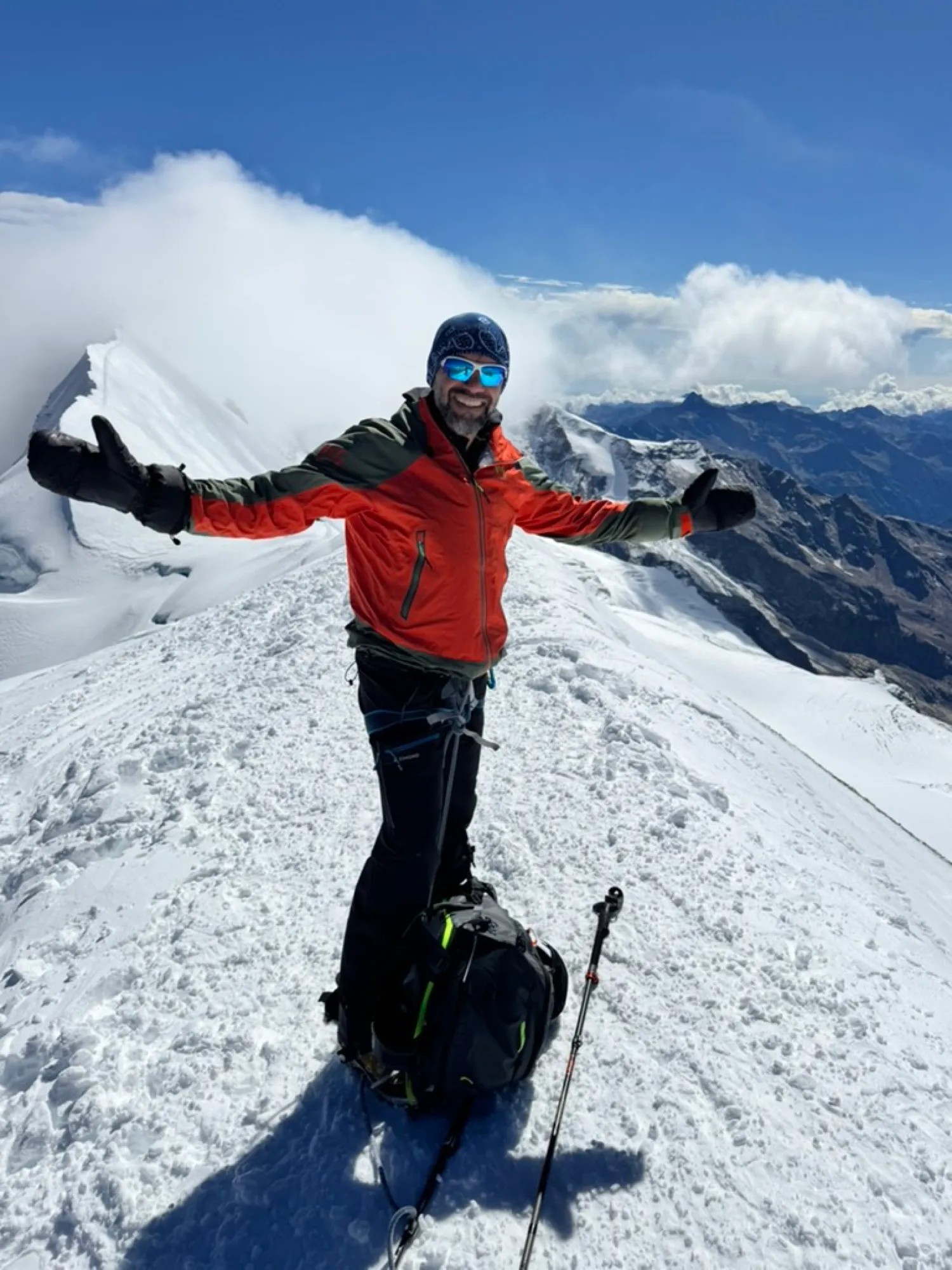
And then the ledge. The knife’s edge of the summit, and the sun coming up.
I have had few mornings like that one. We stood on a rim of snow above the clouds, the world falling away on both sides, and the light came across the top of the cloud sea and lit the highest peaks one by one, the four-thousanders standing out of the white like islands. The strange thing, which I still cannot account for, is that the fear and the exhaustion did not follow me onto that edge. They simply went. What was left was awe, and a gratitude so complete it was close to grief: to be alive, and whole, and able, to have a body that could carry me here and senses open enough to take it in.
The Japanese have a word for the beauty that does that to you. Yūgen. The deep, dim, mysterious beauty of the world when it lets you feel for a moment how vast and how indifferent it is, and how improbable that you are here at all to feel it. Yūgen cannot be photographed and it cannot be explained, which is the whole of it. It is a beauty you can only stand inside. And a helicopter could have set me on that summit in 20 minutes with the identical view, and I would have felt almost none of this, because the seeing was made of the getting there, of every crampon point and every breath I did not believe I had left. You do not arrive at yūgen. You climb into it, or you never reach it at all.
There was one more thing on that edge, harder to say. Six hundred years ago Zeami, who built the Noh theatre around this same word yūgen, taught his actors a discipline he called riken no ken, the sight of detached seeing: the master learns to watch himself from the outside, as the audience sees him, to see even his own back. On Castor at dawn I did it without trying. For one clean moment I was both the man standing on the edge and someone a little apart, watching him, and what that watcher saw was a person who had chosen this, chosen the whole unlikely epic of it, and walked himself the entire way up into a life he had until then only imagined.
I was not only living it. I was watching the man who had authored the whole improbable climb, and himself along with it, and that sight, more than the summit, was what I had come all this way for.
The plan had a hard benchmark built into it: the Matterhorn Test Trail, the straight-up kilometre from Zermatt to Sunnegga that the town keeps as a fitness gauge, 600 vertical metres almost without a switchback, a scramble steep enough to make you forget your own name. I set myself a rule with no appeal in it: under 45 minutes, or I did not get to attempt the mountain. The first times I was not fast enough and knew it in the meat of my thighs before any watch confirmed it, lungs raw, a taste in the back of my mouth like a copper coin, quads burning and then leaden and then refusing to answer at all. I did not schedule the climb until the day it finally came apart clean under me and I came out at Sunnegga inside the time, hands on my knees, retching a little. There. I had earned my own way through the gate.
And the mountain on the other side still said not yet.
It took me months to hear what that was actually saying. I had believed the summit was a reward the mountain owed to sufficient effort, the way a vending machine owes you a can for the right coins: feed it the training, the discipline, the suffering, and the summit drops into the tray. But a summit you can seize the first time you are strong enough was never going to change you. It was only going to reward you, and reward and transformation are not the same country. Nietzsche took a line from the poet Pindar and made it the spine of his life: become what you are. You are not becoming something foreign to yourself, you are becoming what you already, in latency, are. And the self worth becoming recedes as you approach it. The instant you could close your hand around it, it would no longer be large enough to be worth the reaching.
The gap between who you are and who you are becoming is not a flaw in the machine. It is the machine, and it runs on the distance itself. Close the gap and the machine has nothing left to burn: the becoming stops, and so do you.
Which is why the ambition still out of reach after everything you have thrown at it is not a sign you failed. Its distance is the proof it is real, and the fuel that keeps turning you into whoever can finally reach it.
And that was the point of the whole undertaking, though I could not have said so then. You climb into something hard enough that the self living it and the self watching it come apart, and in the space between them you get to see, for once, the person the climb is making of you, while the making is still going on.
You can plan every hour of a month like this, and then life reaches in and rearranges the plan for you. Ibiza was not on it. The invitation came late: a friend’s birthday, and, on the island that same week, another friend I had not seen in a long time. Two reasons to go. And still I did not say yes.
Because the moment the invitation landed, two of me woke up at once and went to war. One was the neophile, the part that runs toward anything new and loud and alive, that would book the flight for the story alone. The other was the one with the vision, the part with a mountain to climb and a plan it did not want touched. Not two appetites pulling on a rope. Two whole ways of being in the world.
We are raised to know which one is supposed to win. The marshmallow test taught a generation that the child who waits for the second sweet grows up to thrive, and the one who grabs the first is ruled by appetite. Delay is character, wanting is weakness. Except the study did not survive its own retest. Run again with ten times the children, the willpower effect mostly dissolved once family and circumstance were accounted for. We are more complicated than one virtue policing one vice.
The night before, I had slept at the Hörnli hut, the stone refuge at the foot of the Matterhorn, on what was to have been my first attempt at the summit. It had come apart over a scheduling conflict with the guides, but I went up and spent the night there anyway, just to know what the eve of it would feel like. I woke at 4, came down in the early light, showered, packed a duffel bag, grabbed a croissant, caught a train, then a plane, and went straight from the airport to Ushuaïa for the last hour of a Martin Garrix set.
Heat and strobe and bass coming up through the floor into my teeth, a crowd of bodies hot and slick with sweat, moving as one animal on the same beat. That is the offer Ibiza makes: the week, and the one after that. I went out one night. One. But I did not pace it. From Ushuaïa the night rolled on to UNVRS, where Fisher came flying in over the crowd on cables and dropped onto the decks while thousands of us roared at once, and I stayed for all of it.
It cost me a full day flat on my back, sleeping and mainlining LMNT electrolytes in a bid to summon my inner Huberman, which I filed under training. A different kind of endurance event. That was the rationalization, and I half believed it. But it stayed one night, not the week the old version of me would have taken, embracing the wreckage as YOLO. When the invitations came for the next one, the better party, the one you would be a fool to miss, I let them go. The morning after the recovery day, rebuilt, I got up into the white light off the sea and ran 10 miles faster than I ever had, the appetite from that night still burning in me, pointed uphill now, at the thing I had come for.
I used to call that restraint. But restraint is a war, one part of you winning while another is punished, and that is not what this was. Richard Schwartz, the psychologist who built Internal Family Systems, has a truer name for it. He sees a person not as a single self but as a whole system of parts, and holds that there are no bad ones, only exiled ones.
Health is coherence between the parts: every one of them welcome, none of them in charge. Self-leadership. You at the helm, the whole crew aboard.
There was a third thing, quieter than the club or the run. One evening I skipped both, drove out to the Sunset Ashram on the western coast, and did nothing at all. I lay back on a lounger above the water as the sun went down, and somewhere behind me a musician took up a djembe and began to play to it, low and unhurried, less a performance than a rite, a way of honoring the light on its way out. It felt like sun-worship. For the length of a sunset there was nothing to chase and nowhere to be, only the sky going gold and then red on the sea, the drum beneath it, and me somewhere in the middle of both, needing to be nowhere else. Of the whole loud, glittering island, that silent hour was the piece of it I kept.
Then the island was behind me and I was back in Zermatt, and the last trial was a race.
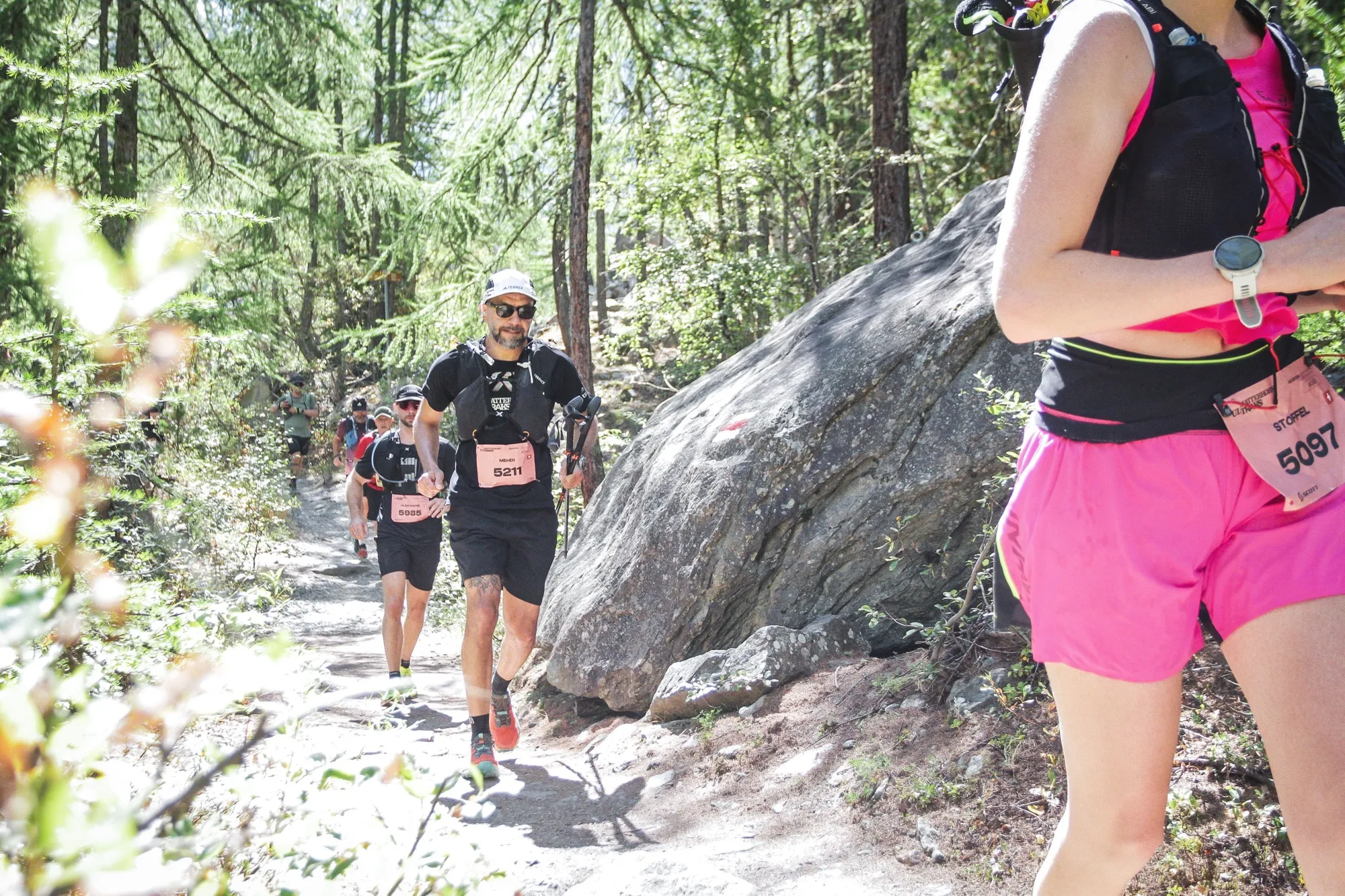
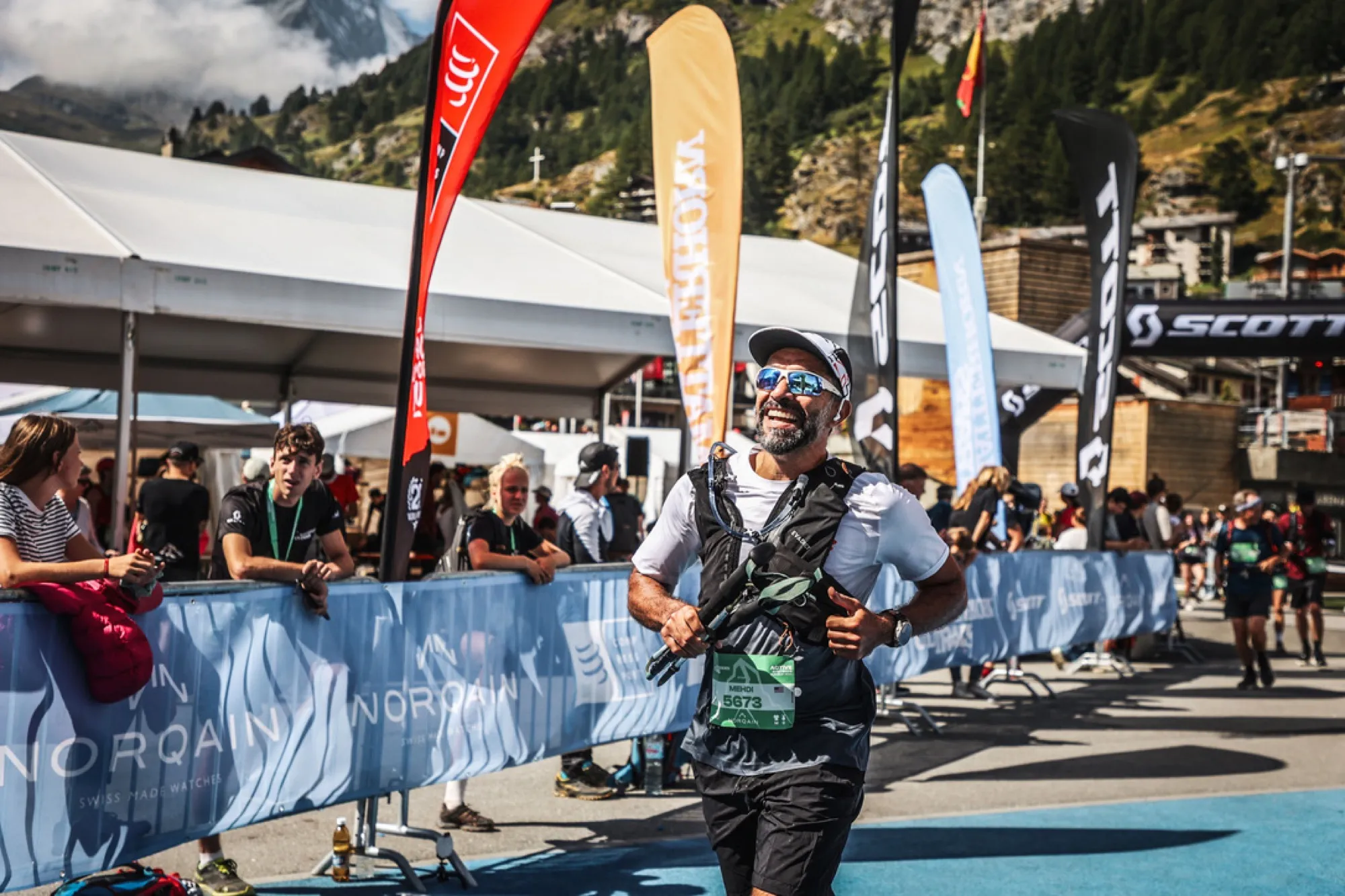
The Matterhorn Ultraks: 32 kilometres of mountain running above the town, 2,000 metres of climbing folded into it, 6 hours and 21 minutes on the clock, stitched together from the same trails I had been rehearsing alone for weeks. I had raced before, this same course the previous year at a shorter distance, but I had never in my life run past 20 kilometres, and this was far beyond it. I thought I knew what the day would ask of me. I did not.
Something moves through a field of bodies all pointed at the same far-off finish that never visits you alone. You could run 32 kilometres by yourself on any mountain on earth and it would cost you everything you had. Run it shoulder to shoulder with a few hundred people spending themselves on the identical rock, breathing the same thin air, and a current runs through the whole field that no single one of them made. It got into me and carried me at a pace my own will could not have held. More than once, as I was coming apart, a stranger dropped back to my shoulder and ran at my pace a while, saying the small nothing things you say, until my legs remembered how. None of them knew my name. All of them, for those minutes, were on my side.
And once, the whole race stopped. On a steep downhill near Furi a Swedish runner went down hard and came up limping, and for a moment it ceased to be a race at all. Half a dozen of us gathered around her, one crouched with her, one waving for help, the clock forgotten by everyone who a second before had been racing it. Then she was in good hands and we went on. No one had decided to stop. We simply had, all at once, before thought.
There is a name for what takes hold of a group like that. Victor Turner, studying people in the middle of a rite of passage, the threshold hours when the old self is gone and the new one has not arrived, found that a particular bond forms among them. He called it communitas: the intense, level solidarity of people all crossing the same threshold at once, cut down to the same bare condition, briefly relieved of every rank that divides them anywhere else. On that course we were all reduced to the same few things. A body, a breath, a next step, a far summit. No one stood above anyone. And out of that levelling came an energy I have felt almost nowhere else, one that belongs to the group and not to any person in it, and lends itself to each of them exactly when their own gives out.
It was on the descent that my own gave out. I had climbed strong, come over the high point at Schwarzsee with plenty in the tank, certain the worst was behind me. Then the last 10 kilometres, and the thing I had failed to account for caught up with me: not my fitness, which was fine, but the sheer volume I had poured into my body over those months, ramped up too far too fast instead of built gradually, and now my body was charging me for every mile of it, one jarring step at a time. My knee flared into a searing catch on every downhill stride and I kept pulling off the trail to stretch it loose enough to keep moving, other runners passing me. The mind offers you dignified exits in that state. You did well, it says, very reasonably. Walk it in from here. I ate a gel that tasted of chemical citrus and warm plastic, got moving again, and what kept me converting pain into forward motion came from the field, not from me.
Almost nothing that remade me that month happened alone. A rope to a guide who could read a darkness I couldn’t. A hand on a shoulder in the fifth hour. A whole pack stopping for a stranger on a downhill.
A month of it. And it bought me exactly one thing: the right to stand in the Hörnli hut and be told not yet.
It took me the walk down, and a long while after it, to see the shape of what had happened. The mountain was never grading me. My readiness and the mountain’s willingness were two entirely separate weathers. I had spent a month perfecting one, and no quantity of it laid a finger on the other.
The Greeks kept two words for time, and we have mostly forgotten the second. Chronos is the time you can count: the month, the 45 minutes, the 6 hours and 21, the stuff a watch is built to measure. But kairos is the other time, the opportune moment, the ripe season, the aperture that opens and shuts on its own schedule and answers to no ledger of what you are owed. You cannot train your way into kairos. You can only be ready when it opens, and honest enough to know when it hasn’t. Not yet was a statement about kairos, not a verdict on chronos. The mountain had nothing to say about whether I had done enough. It was speaking only about the hour, and the hour was never mine to set.
And the mountain, I have come to think, is the least of the places you will hear those two words. You will hear not yet from the person you are finally ready to love, who is not ready for you. From the friendship that goes quiet for a season you cannot shorten. From the venture built correctly in every particular, waiting on a market that has not turned. From the recognition that comes for everyone but you, the year you earned it most. We treat every one of them as a scoreboard. We read the closed door as a report card. And a great share of all human suffering is just this single confusion, run on a loop: mistaking a matter of kairos for a matter of chronos. Reading not yet as not enough, and then, by slow degrees, not enough as not you. A matter of timing, turned into a verdict on your worth.
You are reading this, most likely, at the foot of your own version of that ridge. You did the work that should have begun the thing, and the thing has not begun. Something looked at the sky and said not today, and you are turning it over, trying to decide whether it means you failed. It doesn’t. It means the hour was never yours to set, and that the wanting you are sitting inside, held and unspent, is the engine of everything you are still becoming.
I came down from the traverse the way you come down from a mountain that gave you exactly what it meant to. Quiet, but a different quiet than the walk to Schwarzsee had been, something closer to having been let in on a secret. Because the mountains you conquer are finished with you the moment you stand on them. They become anecdotes. The one that denies you keeps you.
There is something almost merciful in a refusal like that. The wanting does not die when the mountain says not yet. It sharpens. It waits. It is shaping you, in the waiting, into someone the yes can finally land on. The charge is in the holding, and whatever you take too early you never really earned. Not yet.
Which is why I had to go first. You cannot lead people up a mountain that has never turned you back. A guide who has only ever succeeded has nothing to offer at the threshold, because the threshold is the long exposed hour when the thing you trained for does not come and you have to decide what you are without it. I needed to stand in that hour myself, all the way, undefended, before I had any right to bring another person to the foot of their own.
For most of my life I would have taken those two words, from a mountain or a lover or a room, as a verdict on me. A yes, too soon, to any of it, would have handed me the thing and left me exactly the man who wanted it. The refusal went to work on that man instead.
Two weeks after the Matterhorn denied me, I tore up the plan I had spent the whole year making. I was supposed to be moving to Austin that fall. Instead I took on something I was nowhere near ready for, and the denial was exactly why I could. A month of hurling everything I had at a mountain that still said no had burned the fear of failing out of me. I left Providence and moved to Provence, within sight of Mont Ventoux, and began building a home there called Cœur du Mistral, where I bring the same protocol I had just run on myself to the people who reach the last ridge of everything they prepared for and hear, exactly as I did, not yet.
Only much later did I understand whose mountain had been on my horizon all along. Of every peak on earth, it was Petrarch’s. Francesco Petrarca, the fourteenth-century Italian poet later ages would call the father of humanism. In the spring of 1336 he climbed it for no reason but to enjoy the view, and at the summit he opened the small copy of Augustine he carried everywhere and read the line he never forgot: “Men go about to wonder at the heights of the mountains, and the mighty waves of the sea, and the wide sweep of rivers, and the circuit of the ocean, and the revolution of the stars, but themselves they consider not.” He had climbed for the view. But the effort of reaching it was what turned the lens around, off the horizon and onto the one who had been doing the looking all along. He climbed a mountain, and what he found at the top of it was himself.
The mountain is the instrument. You are the object it works on. The outer ascent is a pretext the soul uses to arrange an inner one, and the inner one does not require you to reach the top. It asks only that the climb toward it demand something of you.
And so I had moved, without knowing it, to the foot of the very mountain Petrarch had climbed. There is a word for a coincidence too perfect to be one, where serendipity and synchronicity collide, and that word turned out to be the name of the city I had left.
Providence.