Field note
The Liminal Odyssey
How embodied epistemology taught four friends what philosophy couldn't.
By Mehdi Moutahir
A personal reflection on the first Liminal Odyssey and the year that followed it into the mountains. These were the early, improvised versions, and both the experience and what they taught me inform what comes next.
The same conversation for thirty years.
Different people, different countries, different decades. Always the same loop. Always trying to articulate why. Why I do what I do. What I’m building toward. What it means.
It’s always the same: we analyze. We theorize. We chase clarity. We build frameworks, reference Campbell and Jung, whoever might decode the pattern.
And every time, just when we think we’ve got it, the answer dissolves. Every insight births three new inquiries.
I’ve done this as professor, coach, mentor. I’ve facilitated it for students, entrepreneurs, artists. People at thresholds, seeking solid ground before they jump.
The irony: I teach transformation while trapped in my own recursion.
Until I met Jackson.
The Meeting
Miami. The M.Y.X., a creative startup disguised as a school. Its founder, Abby, believed education should be less conformity, more self-creation. Students came to craft their own paths, not follow syllabi.
Sovereign self-creation. That’s what called us both.
For Jackson, it was the first time his future felt like something he could invent rather than inherit. For me, it was a mirror. Two decades into an academic career, I was at my own threshold: leaving the institution, returning to Miami (the same city where I’d lived at his age, almost a lifetime ago), wrestling with identity and relationships, reimagining everything.
Twenty years between us, but I saw my own restlessness reflected: ambition mixed with anxiety, the signature of transformation.
He was moving from dependence to independence. I was navigating midlife.
We were both becoming again.
That shared liminality, that threshold energy, made our friendship possible. We talked about Campbell’s Hero’s Journey, how it guides anyone standing between known and unknown. Our shared mythology, our language for sacred chaos.
But here’s what I didn’t understand yet: genuine self-knowledge is fundamentally social. You can’t know yourself in isolation. You need someone else to make visible what would otherwise remain implicit.
Martin Buber names this I-Thou: selfhood emerges only in authentic relation with others.
Jackson and I weren’t just two people chasing answers independently. We were creating a space where insight could emerge that neither of us could reach alone.
We were still just talking about transformation, though. We hadn’t lived it yet.
The Odyssey
The next chapter came through Jonas, a French business development associate at a marine tech startup in Boston, another bright young mind filled with dreams, ambition, and contagious enthusiasm. He’d joined for love of ocean, found himself in sales calls and co-working spaces instead. When he learned I coached adults in transition, he offered coffee.
That conversation revealed an intersection: my passion was creating fertile spaces for self-understanding and transformation. His was sharing his love for ocean and sailing. What if we explored the intersection of our respective ikigais?
Two more coffee dates and that question turned into: let’s make shit happen next summer. Only 9 months away.
Jonas and I sketched the vision: a week-long voyage across the Aegean, island-hopping through Greece, using the Hero’s Journey as map and the sea as teacher.
I called Jackson and Max. Didn’t even finish explaining before they were all in. 100%. “Boat, Greece” was enough. Both committed time and energy immediately.
That’s what younger selves do. Fuck yes! Let’s GOOO!!! No hedging. No “let me think about it and get back to you next week.” Just immediate enthusiasm and openness to possibility.
What happens to us that erodes that? When does caution replace courage?
We met in Providence for a marathon weekend, turning idea into action. Nonstop: website, curriculum, boat reservation, island mapping. Modules, exercises, morning reflections. All planned out.
We each brought our obsession: Jonas’s love of ocean and sail, my fascination with myth and identity, Jackson’s gift for turning emotion into music and film, Max’s tireless pursuit of the examined life.
Part of that curriculum: the naming. We asked everyone who applied, including ourselves, to choose an archetypal name. Not legal names, but identities for who they wanted to become.
Eros Del Toro. The bull who seeks truth through desire, who charges toward aliveness when the path isn’t clear (and has an unfortunate affinity for red flags).
Charos Hupomenios. From hupomeno (to endure bravely and calmly) and chará (joy). Grace under pressure applied to creative work, finding joy in the patient discipline of making.
Odysseus Sapphirine. For the Greek hero of Homer’s Odyssey, whose journey home from Troy became the archetypal voyage with its sirens and monsters. Sapphirine for his birthstone in Ayurvedic astrology.
Agnostis Arkadios. Humble in not having answers, devoted to becoming the ideal self. Curious, stoic, mindful. The agnostic pursuing harmony.
An experiment. Permission to become someone we weren’t yet ready to be.
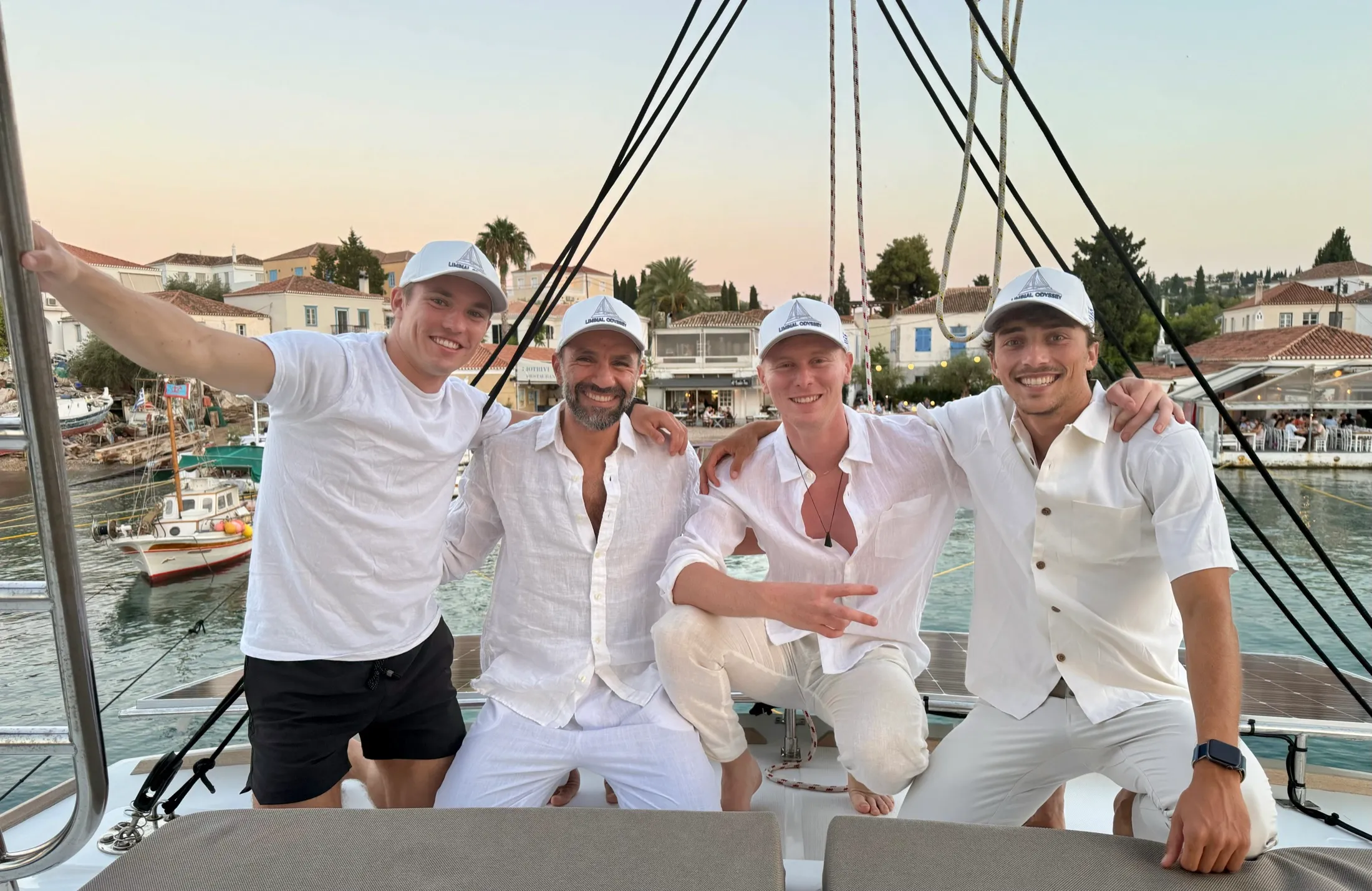
A few months later, Athens. Seven adventurous souls joined us, each carrying their own mythic name, knowing none of us had any fucking idea what we were doing. We’d never tried this. The ultimate MVP: minimum viable product meets maximum vulnerable process.
The early days were magic. In Spetses, we gave the participants an assignment: find the cave if you choose, drawing on Joseph Campbell’s innermost cave, where the hero faces the supreme ordeal. If you go, look deep within at the beliefs that hold you back, face them in the darkness, and leave them behind.
The four of us scouted it first on ATVs. Bekiri Cave, on the far side of the island. Inside, a concrete path winds deeper to where stalactites hang over a sandy beach.
We explored our own limiting beliefs, decided what we’d leave behind. That night, dinner on the beach under the stars. Looking at each other across the table, it hit us: we’d manifested this dream in less than nine months. From coffee conversation to actual boat, actual Greece, actual people trusting us with their transformation.
We’d done it. We were living it.
Little did we know our toughest challenge, our actual innermost cave, was waiting for us in Hydra the next day.
By day three, reality undid the structure. By day four the breaking point was imminent.
Winds shifted. Emotions rose. Fatigue set in. Our curriculum couldn’t contain what was actually happening.
By the time we reached Hydra, the whole program was at the brink of collapse. Not the participants. Us. The four organizers.
We were all impaired. Days of brutal heat, broken sleep, constant vigilance. Too much coffee trying to compensate for exhaustion. Our judgment was shot, our patience gone, our ability to see each other clearly. Gone.
I was treating this as an expensive entrepreneurial test, hyperaware of every cost, every misfire. Through my exhaustion and stress, every action they took looked like vacation mode. Like they’d checked out while I was drowning in logistics and anxiety.
Meanwhile, they probably saw me taking everything too seriously. Missing the magic of floating in Mediterranean paradise to suggest debriefs about the debriefs. The guy who’d spent thirty years overthinking purpose was now overthinking the program designed to help people stop overthinking.
The irony wasn’t lost on anyone.
We couldn’t tell if we were misaligned or just too impaired to see straight. My lens: they’re on vacation. Their lens: he’s spiraling.
Both probably true.
The thought of putting everyone on a ferry home felt less like giving up and more like accepting we’d lost the plot entirely.
But we stayed. That evening, we gave the participants their Hydra assignment: find an object that embodies what you’re learning about yourself. Campbell’s “Return with the Gift”: the transformation must serve the community you return to. Jonas wanted a sextant. Impossible to find on the island, but perfect: navigation by stars when everything else fails.
That’s when we discovered: the real journey wasn’t the curriculum. It was navigating the collapse itself.
The truth revealed itself: transformation doesn’t follow syllabi. It follows attention. And attention is born in disruption, when the comfortable plan shatters and you’re forced to respond to what’s actually happening rather than what you designed.
The Fool appeared, not as tarot archetype but as lived sensation. That mixture of awe, confusion, and courage when plans dissolve.
We thought we were designing a program. The program was redesigning us.
The lesson we’d written into the curriculum became real: You don’t prepare for the unknown. You enter it.
The next day we sailed to Poros, our last stop before Athens. The wind was perfect. We glided smoothly for hours, Alina Baraz drifting through the speakers on the upper deck reserved for quiet contemplation.
The emotional storm in Hydra had passed. Now we sailed under clear skies, literally and figuratively. We were navigating the same waters where Homer’s heroes had journeyed two thousand years before, where the myths of Greek odysseys were born. Homer wrote in the Iliad: “Even as in heaven about the gleaming moon the stars shine clear, when the air is windless… and the shepherd joyeth in his heart.” We’d just lived that. The calm after chaos, ancient words made present in the very seas where they were first imagined.
Jonas still hadn’t found his sextant, but the idea had been working on him. That’s when he told me what it meant. When you’re completely lost in treacherous waters, no GPS, no landmarks, nothing familiar to orient by, the sextant lets you navigate by connecting with the stars. The stable, permanent features of the universe that remain when everything else disappears.
He explained it as practical navigation, but we both heard the metaphor underneath. When the immediate landscape offers no guidance, when the winds of chaos blow, when your carefully designed curriculum collapses on day three, you can’t navigate by what’s changing. The conditions shift. The emotions rise and fall. The plans prove inadequate. All of that is weather, not direction.
You look up instead. You find your bearing not in what’s dissolving around you, but in what remains constant above you.
But what are those stars for humans navigating threshold? Not literal constellations (though those help), but the unchanging commitments that remain when everything else is negotiable. For the four of us, nearly broken on Hydra, contemplating putting everyone on a ferry: we stayed because of what held constant. Not the curriculum. Not the plan. Not even certainty about what we were doing.
We stayed because we’d said we would. Because the friendship mattered more than the stress. Because the commitment to these seven people, who’d trusted us with their transformation, was our Polaris. When nothing else oriented us, that did.
The sextant doesn’t eliminate the storm. It doesn’t calm the chaos or restore the plan. It just lets you find north when everything familiar has disappeared. And sometimes finding north, remembering what you’re actually committed to beneath the anxiety and exhaustion, is enough to keep moving.
We’d nearly collapsed the day before. The stress, the misalignment, the brutal heat. But we didn’t quit each other. We stayed.
Simone de Beauvoir captures what we’d just lived: “La vie garde un prix tant qu’on en accorde à celle des autres, à travers l’amour, l’amitié, l’indignation, la compassion.” One’s life has value so long as one attributes value to the life of others, by means of love, friendship, indignation, compassion. That’s what gave the voyage meaning.
We’d called our program “The Liminal Odyssey,” a name chosen deliberately for the week-long voyage through Greek islands. But as we scattered back to separate lives, we didn’t yet understand what we’d named. We thought the odyssey had ended when we docked in Athens.
We were wrong.
The truth we’d discover over the next year: we’re all always within liminal odysseys, whether we know it or not. Thresholds don’t announce themselves. Becoming doesn’t wait for permission. The question isn’t whether you’re in an odyssey. You are. The question is whether you’ll design it intentionally.
What we’d created in Greece wasn’t the odyssey. It was permission to recognize we were already in one. And perhaps that recognition, that intentional choice to craft and participate in your own becoming, is the essence of sovereignty itself.
We didn’t know it yet, but we’d spend the next year learning what our names actually meant.
After Greece, my body gave me a familiar signal: burnout.
The same depleted feeling I’d experienced five years earlier when I left academia during COVID. We’d done it. Manifested the Odyssey, guided seven people through transformation. But I couldn’t celebrate. Twelve people on a catamaran for seven days. The brutal August heat. The Hydra stress. The constant vigilance of holding space. I’d underestimated by magnitudes the physical and emotional lift required. My nervous system had hit its limit.
I needed solitude.
I went to Zermatt to prepare for the Ultraks trail race. Long hikes alone, supposedly processing what we’d learned. The Matterhorn was visible from everywhere I went. Towering, indifferent, magnificent. With no one to talk to, I started talking to the mountain.
In a mixture of awe and hubris, I said out loud: “I will ascend you next year.”
The mountain, of course, said nothing.
But I didn’t leave it at a declaration to an indifferent mountain.
Back in Rhode Island, I opened my laptop and leaned into something I’d tested the year before but never fully committed to: using my custom Eros Del Toro GPT to co-author the story of what 2025 could be. Not as prediction. Not as plan. As epic.
During the Odyssey, we’d built custom GPTs for all the participants as part of their orientation: digital companions trained on their chosen archetypes. But after Greece, I was the only one who kept using mine this way. Jackson, Jonas, and Max found the practice weird. They teased me about it. We’d discussed the risks in general: losing agency, becoming too scripted, turning life into some tech-mediated performance.
But I had an intuition I couldn’t shake: I get inspired watching movies about heroic protagonists. What if I could be even more inspired if I was the protagonist of my own epic? What if the narrative scaffolding wasn’t a cage but a launch pad?
This was the experiment. The hypothesis that was becoming my life’s work.
So I wrote with my GPT: the Liminal Ascent, a progression of mountain climbs culminating in the Matterhorn. Liminal Dinners where ideas would collide at the intersection of art, psychology, and technology. I crafted it with the same emotional intensity I’d want to feel reading Homer or Campbell. The bull charging toward what called him, even when the path wasn’t clear.
Then I built a website describing the Liminal Ascent as if it were already a real program, a coaching experience I was offering to others. I wrote the program overview, the philosophy, the journey arc. All of it aspirational. None of it existed yet. Artifacts from a future I wanted to inhabit.
The narrative couldn’t climb the mountain for me. But it could make the mountain feel like it was already waiting. Like I was already the person who climbs mountains, who hosts transformational dinners, who lives at the threshold of becoming.
The Fool doesn’t just stumble forward. Sometimes he writes himself a myth worth walking into.
The Year of Embodiment
After Greece, we returned to separate paths. But something had shifted. The sea had loosened our certainties.
The next phase wouldn’t be intellectual. It had to be lived through the body.
Here’s what Western philosophy has taught us for centuries: think, therefore know. Know, therefore act. Contemplation precedes action. Understanding comes first. Plato, Descartes, the entire Enlightenment tradition. They all say: figure it out, then do it.
But what if that’s backwards?
We kept trying to understand before living, to find our purpose, to discover our true selves. But clarity never came. Every answer dissolved into new questions.
The Fool reverses the hierarchy: action is not the application of prior knowledge. It is the primary site of knowledge production.
And the deeper truth we didn’t realize yet: there is no stable self to discover. We’re taught to “find ourselves,” as if there’s a true you buried under societal conditioning, waiting to be excavated. But what if purpose and identity don’t work that way?
In On the Genealogy of Morals, Nietzsche dismantles this comforting fiction: “The doer is merely a fiction added to the deed: the deed is everything.” There’s no essential self behind our actions. The self is created through the doing, not discovered beneath it.
What if there’s no essential self, only a series of provisional selves that must be continuously created and shed?
We would learn this through muscle and breath and endurance.
Nietzsche knew: “Man muss noch Chaos in sich haben, um einen tanzenden Stern gebären zu können.” One must still have chaos in oneself to give birth to a dancing star.
That year, we each chose chaos. We stopped chasing understanding and started practicing becoming.
Authentic Choice: Jonas and the Window
Jonas stayed in Greece. Captained a couple more sailings, then recognized the writing on the wall. The start-up was struggling, his contract had a clear endpoint. The conventional script said: find another stable job, advance the corporate career, do what “one” does. Work hard now, sacrifice youth, enjoy later.
Martin Heidegger called this living inauthentically: following what “they” say, what “one” does, the invisible scripts society hands us. Das Man, the “they-self,” is how we avoid choosing based on our own genuine possibilities. Authenticity, he argued, requires confronting our finitude and choosing while the window is still open.
Jonas had always dreamed of crossing the Atlantic by sail. And he recognized something: this window wouldn’t stay open forever. No kids yet. No mortgage. Still young enough that living with four roommates felt like adventure rather than compromise, which meant his savings could stretch further than convention suggested. If not now, when? Later would come responsibilities that might close this possibility.
The Odyssey had shown him what happens when you step outside the script: chaos, yes, but also profound aliveness. If he could survive the emotional storms of Hydra and the literal Mediterranean thunderstorms he’d navigated through on other summer voyages to the Cyclades, he could handle the Atlantic.
Victor Hugo wrote: “Ceux qui vivent, ce sont ceux qui luttent.” Those who truly live are those who struggle. Jonas was becoming what Hugo meant: téméraire. The bold ones who dare, who choose struggle over safety, who launch themselves into the unknown despite knowing its dangers.
He assembled a questionable crew and set out for the open ocean. Homer’s Mediterranean epic translated to Atlantic reality. Sirens, monsters, storms. Not metaphors.
Reflecting on that crossing, the sextant story imprinted in his psyche, he recognized he’d fully become Odysseus Sapphirine. In Ayurvedic astrology, blue sapphire is Saturn’s stone. It reveals truth through trials, brings clarity through hardship. The sapphire truth he learned: some knowledge only reveals itself when you’re truly lost.
He chose authentically. Not because he was ready, but because the moment was right. The doing came first. Understanding followed.
Situated Learning: Max and the Humble Discipline
Max returned to his apprenticeship. Found a successful entrepreneur in the cutting-edge AI space, became his mentee. The twist? Bringing artificial intelligence to the least sexy industry imaginable: logistics. Warehouse operations. Invoice processing. The unsexy infrastructure that makes everything else work.
But the entrepreneur saw potential and gave Max real responsibility. Actual problems to solve. Build the automation pipeline. Design the AI workflows. Figure out how to make software do what three people used to do manually. He was in the arena, wearing the suit and tie, learning operations while simultaneously building the systems that would automate those operations out of existence.
Jean Lave and Etienne Wenger studied apprenticeship communities and discovered “legitimate peripheral participation”: you learn by doing the actual work alongside those who’ve done it. Learning is an integral and inseparable aspect of social practice.
Max couldn’t learn operations management from books alone. He had to participate, legitimately but peripherally at first, in the actual practice. The knowledge emerged through doing the work, not contemplating it. Situated. Contextual. Built through participation.
Somewhere in those corporate hours, suit feeling like costume, every fiber wanting adventure, he recognized what he was doing: embodying Agnostis Arkadios. Humble in not-knowing, devoted to the craft. Aristotle understood this distinction: “For the things we have to learn before we can do them, we learn by doing them.” The agnostic’s path is staying curious enough to ask better questions. Sacrificing the present to build knowledge that would free his future. Though that didn’t stop him from building on the side. Because why not learn more? Unquenchable.
He called me once about a shiny startup opportunity. The kind of thing the old Max would’ve said yes to before they finished their pitch.
I could hear the answer in how he asked the question. He’d already decided to stay. He wasn’t calling for advice. He was calling to make it official.
“Sounds like Agnostis already knows.”
He stayed. Kept grinding the unsexy logistics, kept building on the side. The learner’s path.
Tacit Knowledge: Jackson and the Flowers
Jackson stayed in Miami and made a pact: one year of radical focus. Finish the music, release it without perfectionism, train for an Ironman. He was staying with projects instead of hopping between them, learning to embody Charos, finding chará in the endurance, discovering hupomeno through the discipline. Kierkegaard wrote that “Repetition and recollection are the same movement, except in opposite directions, for what is recollected has been, is repeated backward, whereas genuine repetition is recollected forward.” Joy in the repetition itself. Grace under pressure.
In The Tacit Dimension, Michael Polanyi identifies a form of knowledge that resists articulation. You can’t learn to ride a bicycle by reading about it. We can know more than we can tell.
What Jackson discovered through repetition and discipline was precisely this kind of tacit knowledge: truths that only reveal themselves through sustained practice. But his tacit knowledge wasn’t technical. It was emotional.
He told me once: it felt like stepping into uncharted waters he’d never allowed himself to enter. Standing in what seemed like an empty, scary, blank dark field. The grounds he’d never permitted himself to reach. But in staying there, in that apparent emptiness, he started seeing the glowing flowers that had been rooted there all along.
Months into training, he called me from a cycling session. He’d been staring at his heart rate, his power output, all the metrics that told him whether he was doing it “right.” Then he closed his eyes. Stopped watching the numbers. Just pedaled. Felt the rhythm, the burn, the breath. When he opened his eyes twenty minutes later, he’d been in Zone 2 the whole time. The sweet spot endurance athletes chase. His body had known what his mind was trying to control. That’s when he understood: the metrics couldn’t teach him what his body already knew.
The field wasn’t empty. He just had to let his eyes adjust to the dark. Charos Hupomenios, part theater, part prophecy, had become real through practice.
Jackson now knows more than he can tell about endurance. The knowledge lives in his practiced capacity to keep going when everything screams stop. It’s tacit. Embodied. Real.
Embodied Cognition: The Mountain and Me
I returned to Rhode Island. Started hosting Liminal Dinners: conversations at the intersection of art, psychology, technology. Places where ideas could collide. But the real embodiment was the Liminal Ascent: mountain climbing across the Swiss Alps, culminating in the Zermatt Ultraks trail race and an attempt on the Matterhorn. A designed progression. Trading sea for mountain, bringing myth down to muscle through altitude and endurance.
I trained in my Rhode Island living room: step-ups on a wooden box I’d built myself, Netflix documentaries about mountaineering in the background. I was learning about mountains. I had yet to learn from them.
Maurice Merleau-Ponty challenged the Cartesian mind-body split. “Le corps est notre moyen général d’avoir un monde.” The body is our general medium for having a world. We understand through our flesh, not despite it.
When you’re 13 miles into a trail race, 6,000 feet of ascent behind you, climbing the brutal pitch toward Schwarzsee, knees screaming, lungs burning, every limb begging you to stop, you don’t think your way through. Runners around you are suffering, questioning their life choices. Above, the Matterhorn shines with impossible beauty, indifferent to your pain. And in that gap, between the majesty of the mountains and the agony of your body, you can’t philosophize your way forward. You stay. Present to pain, present to doubt, present to whatever arises.
Mihaly Csikszentmihalyi studied this state: “The best moments usually occur if a person’s body or mind is stretched to its limits in a voluntary effort to accomplish something difficult and worthwhile.”
My body wasn’t an obstacle to understanding. It was the instrument of understanding. The knowledge my muscles, lungs, and nerves learned through altitude, cold, and endurance lives there still. Embodied. Irreducible. True.
Before the Matterhorn, there was preparation. A rope climb at Riffelberg. Then the Breithorn. Then Castor. Acclimatization, in theory: 4,225 meters, climbed from the Refuge of the Guides of the Val d’Ayas, roped to Emanuel, my guide for the day. Its summit is a corniced ridge of snow that falls away on both sides. My body was already learning what the living-room box steps couldn’t teach it. Altitude. Exposure. The particular focus that arrives when the ground on either side of your boots simply ends.
I’d declared to the Matterhorn exactly 12 months earlier: “I will ascend you.”
The mountain refused. Twice the weather turned deadly. The night before my second attempt, a Korean climber fell to his death. No guide would take me. The conditions weren’t negotiable. Reality had spoken.
Simone de Beauvoir understood: “Pour qu’il y ait action, il faut qu’il y ait ambiguïté.” Freedom isn’t the absence of constraint. It’s choosing within constraint.
So I decided to go for the Traverse. The Breithorn Traverse, the treacherous one. Not the summit I’d reached in prep, but the full exposed spine of snow and ice, with Thomas on the rope. I slipped. More than once. Each time the rope caught me, and I had to keep moving despite the terror. I made it across. Not because I was brave. Because he held the rope and I kept climbing.
I learned both lessons: surrender when reality says no, commit when possible. And when you slip, which you will, keep climbing. “One is not born, but rather becomes.” The mountain taught my body what my mind couldn’t grasp alone.
The Truth We Learned
Each of us was killing an old version of ourselves. Not metaphorically. Literally. The person Jonas was in Boston died on the Atlantic. The person Max was before the apprenticeship died in the corporate hours. The person Jackson was before Miami died in the training repetitions. The person I was before the mountains died on the ice.
And we had to keep dying. Becoming demands this. It’s not something you do once. You do it again and again, for as long as you’re alive.
Certain forms of knowledge are only accessible through committed practice. They cannot be derived through reasoning alone. They must be lived into existence.
This is what paralyzed us for so long. We kept trying to figure out our purpose before living it. But purpose isn’t discovered through contemplation. It emerges through committed action.
We had designed a program. The program was just permission to start.
Throughout 2025, Jackson and I kept talking.
Always the same pattern: analyze, theorize, chase clarity. Extract a single statement to explain our purpose, a sentence neat enough to hold all contradictions.
Every answer birthed another inquiry.
Philosophers trapped in loops. Builders paralyzed by understanding.
Until one October morning.
The Fall Realization
My phone rang. Jackson.
A few days earlier, he’d texted me a question: “Do I need to live my life analyzed this much?” We’d both been sitting with it, looking forward to this call.
The conversation started like all the others. Eager to explore the question, to chase its implications. But then we heard it: the absurdity of analyzing whether we analyze too much. How the very act of “seeking the answer” kept us from living it.
We laughed. Then fell silent.
In that pause, the realization landed:
The doing is the answer.
The Fool had been with us all along. Not as failure to know, but as state of grace.
The Fool acts without needing certainty. Learns by walking, not watching. Falls, rises, improvises. Mistakes the plan for the path until he realizes: the plan was only ever a reason to begin.
We saw it clearly: the hero’s journey isn’t linear, problem to solution. It’s a recursive dance between knowing and not-knowing. Each answer builds the next question. And here’s what thirty years of recursion finally revealed: the recursion isn’t a bug. It’s the system.
For decades, I treated questions as problems to solve. Each question an obstacle between me and the answer. But “Why do I do what I do?” doesn’t have an answer that, once found, renders the question obsolete. The question transforms through the process of living with it.
Purpose isn’t a destination. It’s a dialogue.
Then Jackson said something that stopped me.
“All you lose is what you built for a person you no longer are.”
That sentence carried everything. Not just the year, but the thirty years of recursion before it. The shedding, the becoming, the rebirth. Every version of myself I’d built and outgrown.
Including the versions I’d tried to author into existence.
I’d used my Eros GPT to write 2025’s chapter: the Liminal Ascent, the Liminal Dinners, and even shorter epics around menial tasks and projects. I was turning everything into mythology. Cleaning my apartment became “The Great Purging.” A weekend hike became “The Ridge of Revelation.” My friends thought I’d lost it. Maybe I had. But the bull charging toward desire doesn’t discriminate between mountains and mundane. He just charges.
I’d created artifacts, websites, narratives. All scaffolding for a future self. The compelling vision finally got me moving.
But here’s what the mountain taught me that the GPT couldn’t: the narrative gets you to the trailhead. The embodiment teaches you who you become on the trail.
I heard something in how Jackson said it. In his voice, the quiet certainty. A freedom I wanted, a peace I was reaching for. Not because he’d figured it all out. Because he’d stopped needing to.
The AI helped me design the interruption. The body had to live it.
I sat with it. Felt something release. Like I’d been holding my breath for three decades and finally remembered I could exhale.
It was October morning in Rhode Island. The air had that particular fall sharpness: crisp, clarifying, the kind that wakes you up. The shedding had just started. The maples along my street were a quarter way through their transformation: hints of crimson and amber breaking through the green, some leaves slowly drifting down while most still held on. The wind would catch a few and carry them toward the Providence River. The leaves had it figured out: shed the branch, drift downstream, taste the ocean before you die. Their own small odyssey.
The season was showing me what Jackson had just named: you can’t become the next version until you release the last one. The trees weren’t suffering their loss. They were trusting the cycle. Grace in the letting go.
The Fool’s wisdom: transformation requires shedding an old identity.
We realized our entire friendship, from M.Y.X. to Greece to this call, was one long apprenticeship in that truth. The boat, the mountain, the triathlon, the conversations. All different expressions of the same human impulse: to become through doing, not through knowing.
The philosopher Hans-Georg Gadamer spent his career exploring this tension: interpretation is an infinite dialogue, not a march toward final truth. There’s no meta-story that explains all stories, no ultimate purpose that subsumes all purposes. But this isn’t nihilism. Meaning is perpetually under construction. And the construction happens through the act of questioning.
We ended the call with laughter and a strange quiet joy.
The Fool never graduates. There’s no final state of wisdom. No completion. Each time he sheds, he begins again. Wisdom isn’t accumulated knowledge. It’s practiced openness. A willingness to repeatedly surrender what you know for what you might discover.
The odyssey we named in Greece never ended. It simply revealed itself to be what it always was: the ongoing practice of intentional becoming. Each of us designing our threshold crossing. Each of us choosing to see the liminal space we’re always already in.
When you stop searching for purpose, purpose finds you. When you stop trying to discover yourself, you become yourself. When you stop clinging to answers, the inquiry becomes enough.